
DEEC TALK with Carla P. Gomes
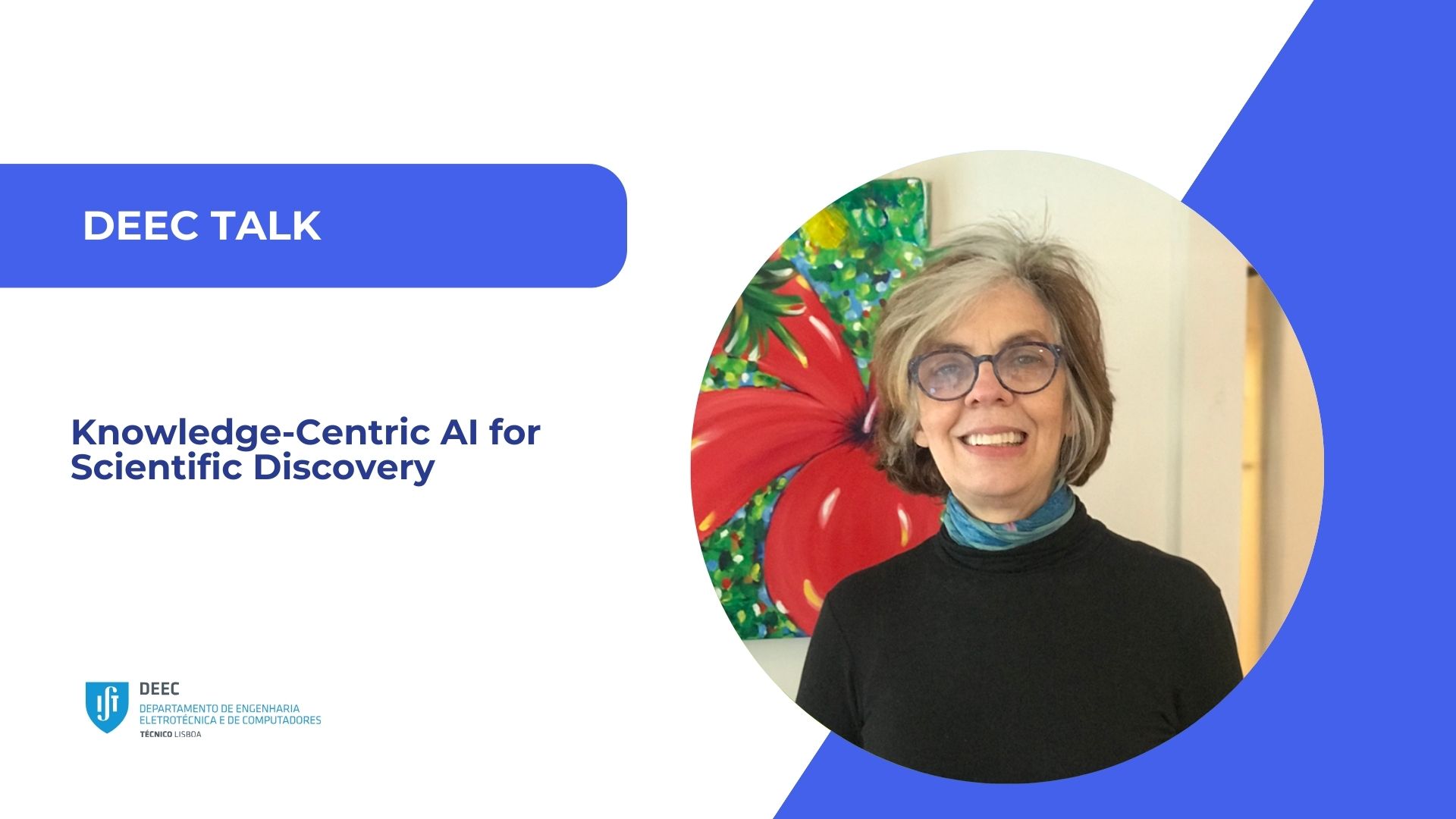
On December 17, the session “Knowledge‑Centric AI for Scientific Discovery” will take place in auditorium EA4. The lecture will feature Carla P. Gomes, Professor of Computing and Information Science at Cornell, director of the Institute for Computational Sustainability, and co-director of the Cornell AI for Science Institute.
About the Speaker
Carla Gomes is the Ronald C. and Antonia V. Nielsen Professor of Computing and Information Science at Cornell, director of the Institute for Computational Sustainability, and co-director of the Cornell AI for Science Institute. She holds a Ph.D. in AI from the University of Edinburgh. Her research spans large-scale constraint reasoning, optimization, and machine learning. Recently, she has become deeply immersed in the establishment of the new field of Computational Sustainability and in AI for Science. Gomes has led two NSF Expeditions in Computational Sustainability, published 300+ articles (including in Nature and Science), and received the 2021 AAAI Feigenbaum Prize and the 2022 ACM/AAAI Allen Newell Award. She is a Schmidt AI2050 Senior Fellow and a Fellow of AAAI, ACM, and AAAS.
Abstract
Data-centric AI has advanced quickly, but it still faces limitations in scientific discovery and high-stakes decisions. I outline a knowledge-centric agenda that combines first-principles reasoning with learning, integrates prior knowledge with data, and allows explicit trade-off analysis for interpretable recommendations. I illustrate this approach in Computational Sustainability, across discovery, prediction, and decision-making: for discovery, Deep Reasoning Networks solve inverse problems, such as inferring crystal structures from X-ray diffraction; for prediction, multi-entity models span species distributions, materials properties, and soil organic carbon; and for decision-making, we develop Pareto-based hydropower planning strategies in the Amazon and address freshwater-fish conservation under the UN 30×30 goal. Overall, knowledge-centric AI accelerates discovery and supports sustainable action.