ElectroStars: Henrique Pocinho
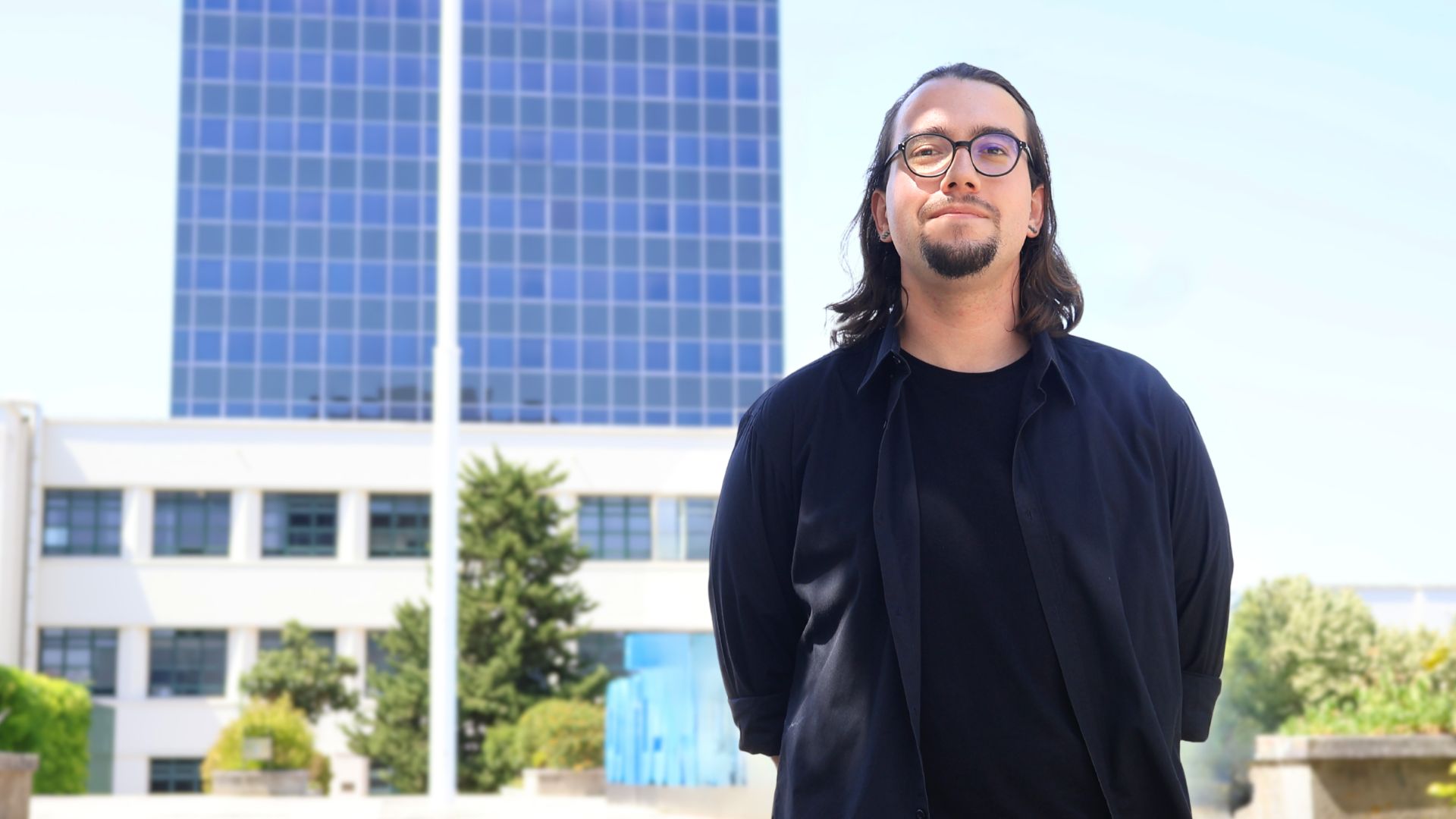
Today, we share an interview with Henrique Pocinho, an alumnus of the Master's in Electrical and Computer Engineering (MEEC) and Chair of Técnico's IEEE Student Branch. Throughout his academic journey, he was a member of HackerSchool, collaborated with INESC-MN and INESC-ID, worked as a teaching assistant, and founded Técnico's IEEE CAS/SSCS (Circuits and Systems/Solid-State Circuits Societies) Student Chapter.
From an early age, Henrique knew he wanted to pursue engineering. During his degree, he had the opportunity to become involved in research at INESC-MN, where he contributed to the characterisation of triboelectric nanogenerators (materials that generate energy through static electricity) as part of a PhD project. Later, he also joined a project led by a PhD student in architecture, which focused on the real-time monitoring of buildings. Inspired by events such as the fire at Notre-Dame Cathedral in Paris, the initiative aimed to enable the early detection of risk situations while producing three-dimensional (3D) scans, creating a detailed record of original structures to support their reconstruction in the event of damage.
Following these projects, Henrique joined INESC-ID and Silicon Gate, a company specialising in power management for integrated circuits, where he carried out his master's dissertation. His work focused on developing an amplifier for signals such as voltage and current to improve the testing and characterisation of electronic circuits. "My thesis aims to overcome some existing physical limitations by creating a customised solution for those applications: it is an amplifier, a bench-top instrument, with capabilities that surpass those currently available on the market," he explains.
I've been passionate about electronics since I was very young, so [when it came to choosing my master's specialisation], there really wasn't a choice—it was obvious. (...) What I enjoy the most is testing and characterisation: you're handed a black box and you have to figure out that something isn't right, identify the problem, and explain why.
Henrique Pocinho, Chair of Técnico's IEEE Student Branch
However, Henrique's enthusiasm for electronics was not limited to research and academic work. Aware of the difficulties many students face in courses within this field, and motivated by a desire to contribute to their learning process, he decided to become a teaching assistant at DEEC. "In secondary school, problem 'A' has solution 'B'—you solve it by applying a specific formula," he explains, stressing that many of the challenges students encounter stem from the difference between the reasoning developed in secondary education and the way of thinking required at Técnico. In electronics, the problem-solving approach is generally more open-ended and goes far beyond the direct application of mathematical formulas, requiring a different way of looking at problems.
The complexity does not lie in the mathematical or conceptual difficulty of the system itself, but rather in the simplifications that can be made.
Henrique Pocinho, Chair of Técnico's IEEE Student Branch
Driven by a desire to demystify the complexity of electronics and share his passion for the field with other students, Henrique also founded the IEEE CAS/SSCS Student Chapter (Circuits and Systems/Solid-State Circuits Societies), Técnico's first student chapter dedicated exclusively to electronics. "Any IEEE student member can create a student chapter (...) and the idea came up at the end of my third year. We realised that very few students were choosing this area of specialisation, and we felt there was a significant gap that needed to be addressed," he explains.
The chapter initially focused on outreach activities aimed at the academic community, such as the IEEE MSc and PhD Microelectronics Talks, where master's and PhD students are invited to present their research. It later expanded its activities by organising workshops for other audiences, including secondary school students, and by developing projects such as MESA.
Following the creation of this student chapter, Henrique Pocinho became Chair of Técnico's IEEE Student Branch in 2025.
My role is management. I regularly meet with the leaders of each chapter, identify their needs, and work together with the rest of the IEEE Student Branch leadership team to coordinate how we can support them and what events we can organise that go beyond the scope of the individual chapters.
Henrique Pocinho, Chair of Técnico's IEEE Student Branch
Today, the Student Branch includes five chapters: CAS/SSCS; RAS (Robotics and Automation Society), dedicated to robotics; EMBS (Engineering in Medicine and Biology Society), focused on biomedical and biological engineering; WIE (Women in Engineering), which organises initiatives highlighting the work of women across science, engineering, and technology; and CS (Computer Society), dedicated to computer science and computing.
This year, Técnico's IEEE Student Branch organised the Local Board Meeting, bringing together members of student branches from universities across Portugal, representatives of IEEE Portugal, and industry professionals. The event fostered networking opportunities and encouraged the exchange of contacts, research interests, and knowledge among participants from different backgrounds.
Regarding current projects, Henrique highlights that students are developing the prototype that will compete in next year's MicroRato competition at the University of Aveiro. In this competition, participants are challenged to build a robot capable of solving a maze in the shortest possible time. "There are two competition modes: the blind mode, where the robot starts at one point and must reach the destination while exploring the maze as it moves, and the planning mode, where the robot is given a set amount of time to explore and memorise the map before attempting the run," Henrique Pocinho explains.
I think that, throughout my time at Técnico, my biggest challenge was managing my time, prioritising tasks, and knowing when to stop. Some tasks are more important than others, and whatever doesn't get done today can always wait until tomorrow.
Henrique Pocinho, Chair of Técnico's IEEE Student Branch
Reflecting on the challenges he faced throughout his academic journey, Henrique Pocinho points to time management as one of the main difficulties at the beginning of his studies. Balancing extracurricular activities, academic work, research, and time to rest ultimately helped him strengthen his planning and organisational skills.
He also emphasises that his experience at Técnico played a key role in developing his proactivity. "You need to be willing to make decisions," he says, recalling that this mindset guided both the creation of the IEEE CAS/SSCS Student Chapter and the development of numerous projects throughout his academic journey.
[If I had to describe my time at Técnico in one word, it would be] 'transformative.' It was a challenge, but when you truly enjoy what you do, the effort is worth it.
Henrique Pocinho, Chair of Técnico's IEEE Student Branch
Henrique Pocinho is currently pursuing a dual-degree PhD programme involving Técnico and the University of Macau. In the future, he hopes to become a university professor.