ElectroStars: Miguel Andrade
In this edition of the ElectroStars feature, we interviewed Miguel Andrade, a student of the Master’s in Electrical and Computer Engineering.
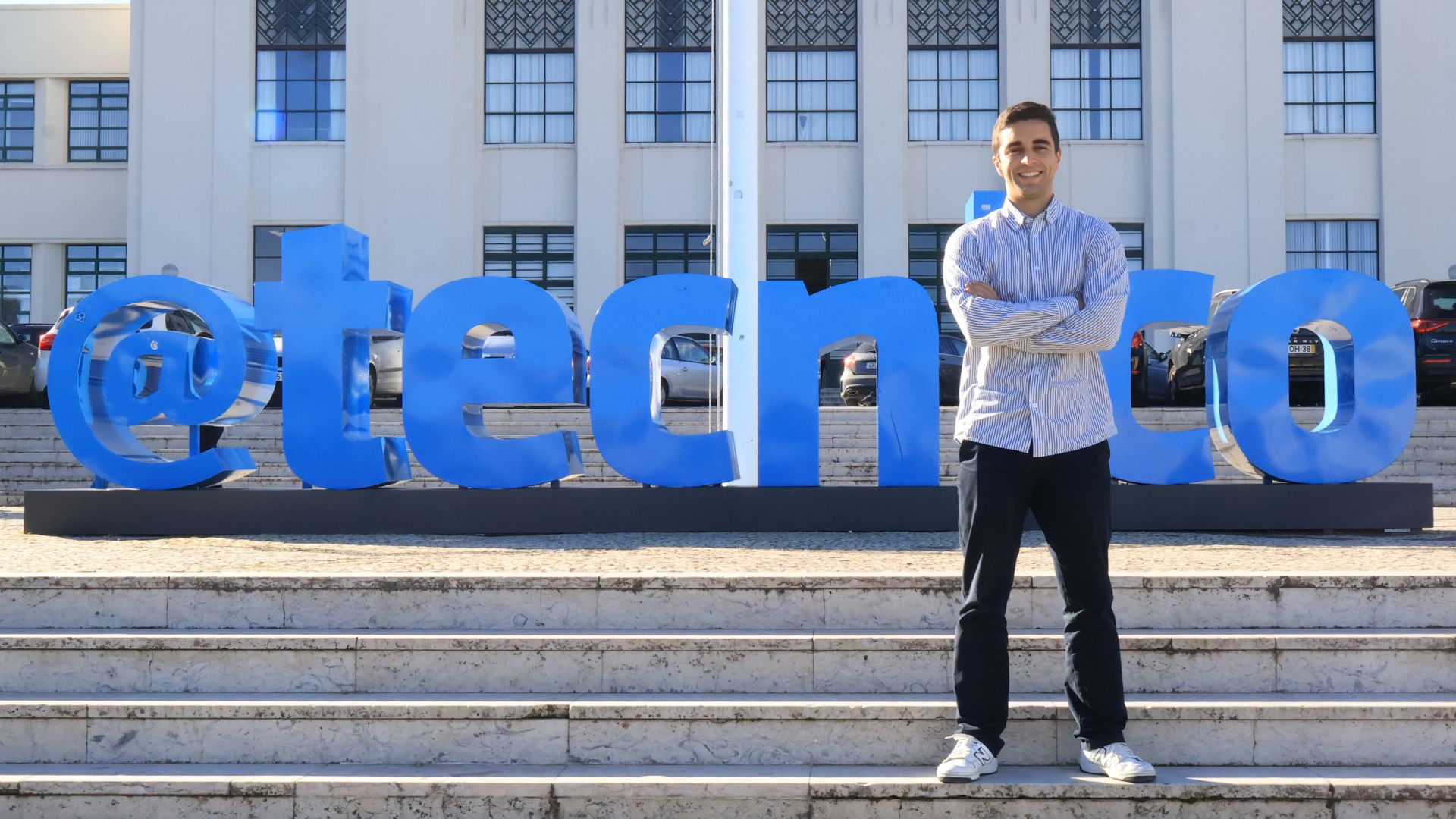
Miguel Andrade, a student of the Master's in Electrical and Computer Engineering, won the latest edition of the Cisco Merit Award in Network Architecture and Management. In an interview with DEEC, the student shared a bit of his journey, from choosing the course to the present moment.
From an early age, Miguel Andrade showed interest in science and technology: "I knew I wanted to pursue engineering because I liked mathematics, physics, and chemistry," he says. When he finished secondary school, he decided to apply for the Bachelor's in Electrical and Computer Engineering at Técnico as his first choice, due to the course's focus on the connection between the physical and digital worlds, including its practical component. He highlights that contact with different scientific areas throughout the degree made him reflect on the role of electrical and computer engineers in technological development, seeing it as something essential today and with a strong impact on the future.
In terms of technology, electrical and computer engineering is always present. [Choosing this course] is a safe bet for the future.
Miguel Andrade, student of the Master's in Electrical and Computer Engineering
During his bachelor's degree, he joined the Electrical and Computer Engineering Student Group (NEEC), initially as a collaborator and later as vice-president, something he highlights as having provided him with skills such as teamwork, human resources management, and communication with different types of audiences: "it's something you don't learn in theory," he notes. He was responsible for organising workshops, where he and other group members shared course-related knowledge with university students during the academic year and with secondary school students through activities such as Verão na ULisboa. He also took part in team management at NEECHathon, an annual initiative promoted by the group that challenges students to develop projects over a weekend, as well as in creating the event’s promotional website.
[With athletics I learned] to always want to go further, step by step, and that is reflected in academic life.
Miguel Andrade, student of the Master's in Electrical and Computer Engineering
In addition to participating in NEEC, his passion for the course also contributed to his focus on studying, which he notes was recognised through two merit diplomas in 2022 and 2023, and the Técnico academic excellence diploma in 2024.
The Cisco merit award recognised his work in network architecture and management, an area he was already interested in. In this course unit, students learn how network management and maintenance work, including connecting different devices and some of the communication protocols used. Students are also challenged to develop projects using voice over IP, where they gain the ability to program an automatic call attendant.
Additionally, his interest in the learning process also led him to tutor basic and secondary school students in mathematics and physics and chemistry, reflecting the value he places on knowledge sharing among young people.
When asked how he managed his time, considering all these activities carried out throughout the course along with his studies, Miguel Andrade highlights the importance of setting goals and planning different activities, including sports practice.
The most important thing is organisation: having everything well planned, visualising deadlines, and never letting tasks pile up.
Miguel Andrade, student of the Master's in Electrical and Computer Engineering
Currently, his schedule includes athletics practice. This year he took part in two half marathons and a marathon for charity. "I try never to give up sports; I find it really important — physical health is connected to mental health," he says. Although he had some difficulty managing time at the beginning of his degree due to adapting to university-level demands, leading him to leave competitive athletics, he admits he could not completely give up sports. Besides contributing to his well-being and improving his focus on learning, running also strengthens his resilience, something he applies when solving academic challenges.
On the other hand, his journey at Técnico strengthened his constant desire to learn more, something he says is essential in the job market. Today, he is an engineer at MeterBoost, a company specialised in manufacturing smart batteries. He is responsible for developing software that configures battery behaviour, enabling remote updates and monitoring of their state. In the future, he intends to work in machine learning, due to the wide range of possible applications.
The algorithm can identify, for example, a tumour or which genes are being expressed in it, something that can be used in therapies.
Miguel Andrade, student of the Master's in Electrical and Computer Engineering
For this reason, he pursued a master's with a specialisation in control, robotics, and artificial intelligence. He is currently developing his course integration project (PIC2), supervised by Catarina Barata, a researcher at the Institute for Systems and Robotics (ISR). His project aims to predict gene expressiveness in human tissue cells by analysing images. Detailed images of cells are initially presented along with their corresponding data, training the algorithm to recognise gene expressiveness in new images using neural networks. This research area aims to contribute to developing more personalised therapies, optimising treatment for different patients.
However, although there are many advantages to using artificial intelligence tools, Miguel Andrade emphasises the need to also consider the risks, particularly the loss of critical thinking skills. "As students, it's important that we don't depend on AI to solve problems," he stressed, concluding the interview by inviting students — who currently have access to these tools — to reflect on how they use them.